The vanished island of Testerep was part of an ancient barrier-island system

The final report of the four-year FWO project Testerep reveals a surprisingly rich history of the Belgian coastline. Where the North Sea now ripples, there once stretched a dynamic landscape of sandy islands, tidal channels, mudflats, and salt marshes, comparable to today’s Wadden Sea. The island of Testerep, once situated between Nieuwpoort and Ostend, formed a crucial link in that ancient barrier-island system.
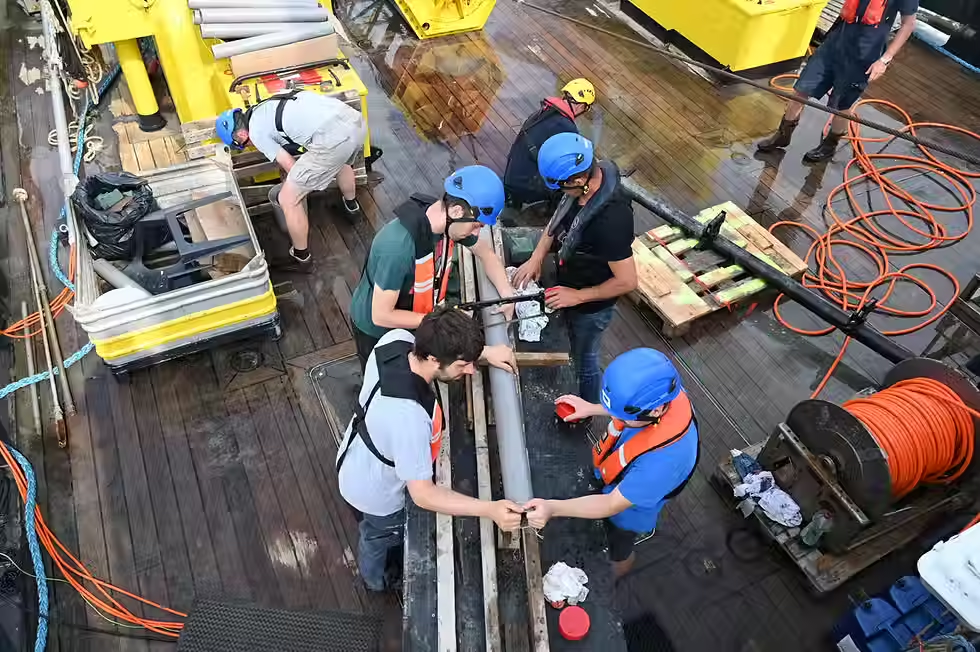
Researchers from the VUB, VLIZ, and KU Leuven used drill cores, seafloor scans, and dating techniques to reconstruct how the coastal landscape evolved. They discovered two ancient, buried tidal channels off the coast, clear evidence that Testerep functioned for centuries as a barrier between the sea and the tidal basins behind it. Further offshore, they identified sandy coastal deposits marking the island’s former seaward edge. Beneath today’s Stroombank, a sandbank that began forming around 700 CE, these old deposits turned out to be remarkably well preserved.
On the landward side, archaeologists uncovered thick peat layers cut through by ancient channels. This material shows that a quiet intertidal zone lay behind Testerep. Combined with the offshore findings, the research paints a clear picture: for at least four millennia, the central Belgian coast consisted of sandy islands and extensive tidal flats.
Between the 3rd and 8th centuries CE, the island gradually began to disappear. The exact cause remains uncertain. The researchers point to possible shifts in storm activity, sea-level rise, or sediment supply. What is certain is that around 700 CE the Stroombank formed on the remnants of the eroding coastline. By around 1200 CE, signs of severe coastal erosion are evident, including places where ancient channels were abruptly cut off.

The team stresses that this past holds important lessons for our future. Even though sea-level rise in the past was relatively slow (about 0.7 millimeters per year) the coastline still moved roughly three kilometers inland over a span of 1,500 years. “Believing that the coastline will simply stay where it is now, without addressing climate change, is an illusion,” says project coordinator and VUB archaeologist Soetkin Vervust.
The Testerep project offers policymakers and the wider public a scientifically grounded reconstruction of a vanished island and a mirror for today’s challenges. It shows that coastal landscapes are always in motion, and that timely action can make the difference between preservation and loss.


Comments