Genetics and reproduction: medical possibilities and ethical limits

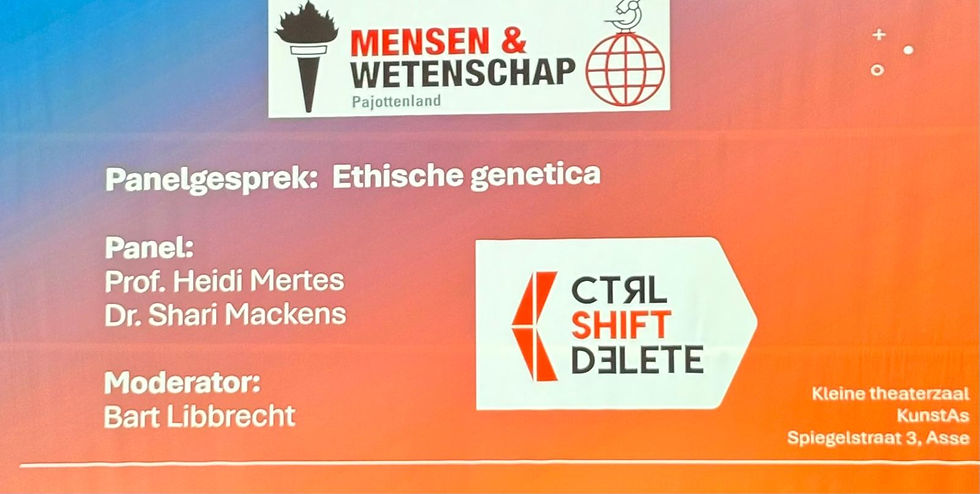
In collaboration with OSB-VUB , Mensen en Wetenschap Pajottenland brought together two leading experts for a panel discussion on ethical genetics and reproductive choices on Saturday January 17 in Asse.
Professor Heidi Mertes (UGent) and Prof. Dr. Shari Mackens (VUB/ UZ Brussel) discussed from ethical and clinical perspectives respectively how genetic technologies are increasingly impacting individual choices and society as a whole.
Professor Heidi Mertes is a professor of medical ethics at Ghent University and affiliated with the Ghent Bioethics Institute and the Metamedica research group. Her research focuses on ethical issues surrounding medically assisted reproduction, genetics, and embryo research, and more recently on the impact of new technologies in healthcare, such as artificial intelligence, big data, data security, and privacy.
She strongly warned against the commercialization of genetic testing. Increasingly, comprehensive genetic analyses are offered directly to consumers, regardless of medical necessity or professional guidance. Such tests can detect genetic variants whose clinical significance is unclear, leading to uncertainty, anxiety, and sometimes incorrect conclusions. Moreover, it is often unclear what happens to the collected genetic data, which is commercially valuable and can potentially be reused or resold.
"When genetic information becomes a commercial product, the focus shifts from care to profit. This poses risks to privacy, correct interpretation, and patient well-being," says Mertes.
From a clinical perspective, Prof. Shari Mackens, head of the Fertility Diagnostics and Treatment, Implantation Failure and Pregnancy Loss, Reproductive Genetics and Immunology department at the VUB, provided insight into the realities of IVF and preimplantation genetic testing (PGT). She outlined how doctors face difficult decisions daily regarding embryo selection and transfer, carefully balancing medical guidelines, chances of success, and patient wishes.
Various techniques are used in PGT. PGT-A focuses on detecting chromosomal abnormalities , such as an abnormal number of chromosomes (aneuploidy), and is primarily used to select embryos with the highest chance of successful pregnancy. PGT-M focuses on detecting specific genetic abnormalities , such as monogenic disorders that run in a family, and is used when parents have an increased risk of passing on a hereditary disease. Both techniques aim to transfer only embryos that are free of genetic or chromosomal abnormalities.
Mackens emphasized that these tests are used strictly for medical purposes and that clinical practice is deliberately limited to genetic abnormalities with clear health implications, precisely to avoid ethical derailments.
A concrete example is BRCA (Breast Cancer). Every person has BRCA genes. When a gene has an error, a mutation, the risk of breast and ovarian cancer increases significantly. If one parent carries a BRCA gene mutation, a child has a 50% chance of inheriting it. This explains why some couples start IVF without fertility problems, but do so to avoid genetic risks through PGT-M.
"For patients, it's not about abstract technology, but about real health risks and challenging processes. This requires careful guidance and clear boundaries," Mackens emphasized.
The panel discussion highlighted a growing tension between medically responsible genetic testing and an international market offering increasingly more and more extensive genetic selection options. While clinics operate within strict guidelines and ethics committees, commercial providers often operate in a gray area, risking deception, inequality, and normative pressure around "healthy" or "desirable" traits.
The panel discussion underscored the importance of continued ethical reflection, regulation, and public dialogue. Genetic technologies offer significant medical opportunities, but at the same time, they demand vigilance when economic interests threaten to take over.





Comments